
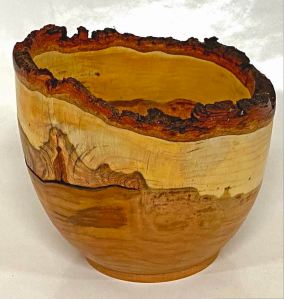
Early in my journey, I turned a small Maple bowl which captured much favorable attention when I shared pictures of it on my Facebook page. This was the first “live edge bowl” I ever turned (meaning the bark was retained on the rim). It was turned from a small section of Red Maple which was toppled during an ice storm in February of 2021, before I my lathe was received. Since I knew I would be getting a lathe I saved the chunk of green wood.
The bowl is 7″ tall and 5.5″ diameter. It was completely turned while it was green (not dried to a stable state). The line between the heart wood and the sap wood creates a view that many described as looking like a Wild West landscape. I naively assumed I would encounter many more pieces of wood like this one, but five years later that has not proven to be true.
I learned about twice turning because of what happened to this bowl. The darkest line in the center left of the photo is actually a significant crack. As the green timber dried out at different rates, the heart wood pulled away from the sap wood and the crack opened up. This loss drove me to learn much about rough turning pieces so drying wood leaves me more options.
Knowing what I know now, I would have tried something different with this bowl. I would have rough turned it leaving the walls and bottom around 3/4” thick. This would have allowed me to put it back on the lathe and return it. Also, once rough turned I would have weighed it and put it in a brown paper bag with shavings.
Drying green wood—without cracks—is an ongoing challenge for woodturners. Different sections dry at different rates. The wood often warps because of those differences, also. As long as you prepare ahead for it, there are ways to mitigate when it happens.
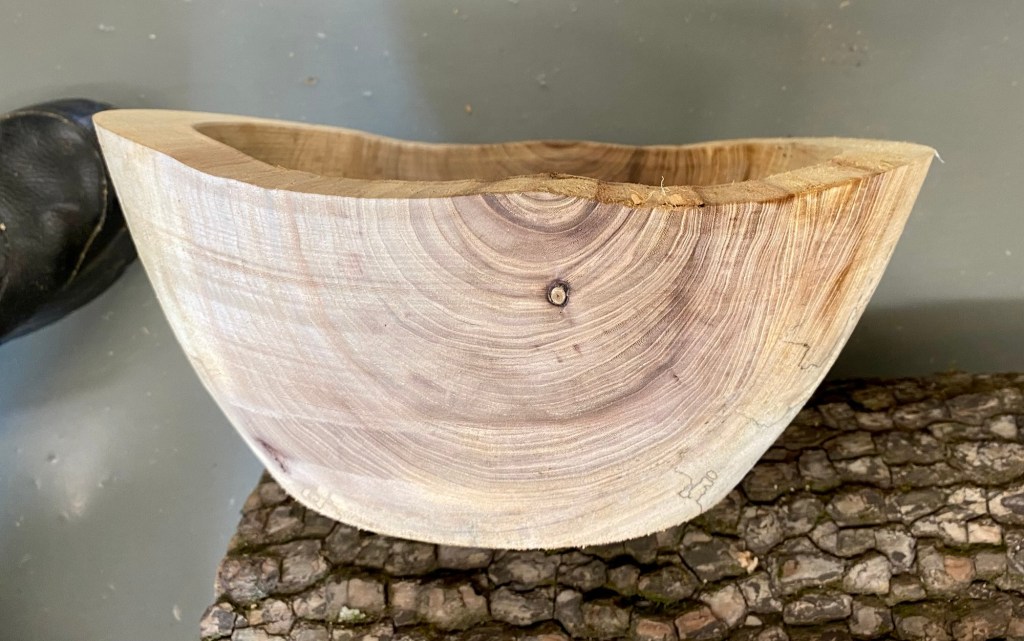
Here is the photo of a rough turned bowl. It is hard to imagine that months earlier the top had been totally flat! Segments were pushed higher and others were pulled lower by the drying process.
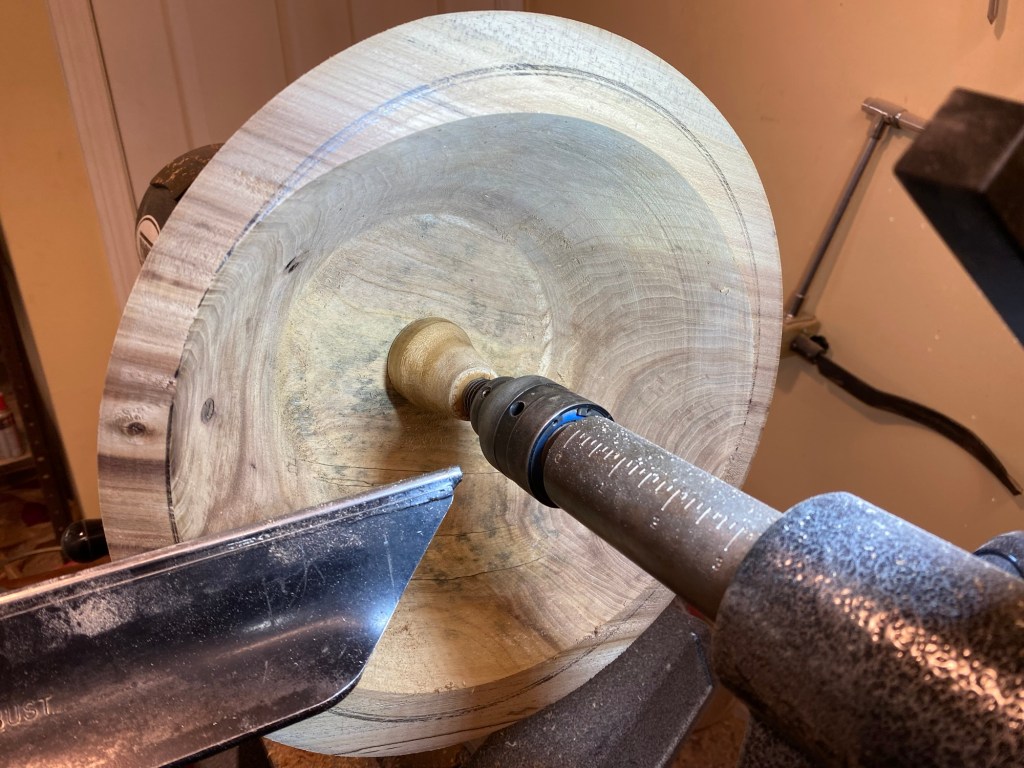
After I flattened the rim shown in the previous image, I drew a circle on it. That pencil mark shows how “oval” this bowl became. Truing it back into a circle required removing side grain on the inside and end grain on the outside. Leaving the rough turned walls 1/10th of the diameter allows for enough thickness to accomplish this.
The Wild West Bowl shown at the start of this post probably could have come out much better, if I had known about twice turning. When you commission an artist, you are tapping into their years of experience. Hopefully their past failures (less than ideal outcomes) will benefit your project.


Leave a Reply