
Ancient History:
Mrs. Manley, my 5th Grade teacher, taught crafts. We made beads out of long strips of wallpaper which were soaked in glue, rolled up on toothpicks which were removed before the glue started drying. We brought in English Walnut half shells which we saved over Christmas. After we shellacked the shells we cut out turtle shapes (head, four legs and a tail from a single piece of scrap leather and glued one walnut half on as the turtle shell. We also made coin purses out of leather kits where we stitched long plastic laces through holes around the outer edges. We could decorate them with shapes that we hammered using dies she had. Learning ways to see creatively was how Mrs. Manley touched me.
After the school building burned, during my 8th grade year at Bell Buckle, our county school system merged it with Wartrace to form Cascade High School. Two gifts came out of that tragedy: several of my best friends grew up in Wartrace, our previous biggest rival in basketball. We likely never would have gotten to know one another because of that rivalry. Secondly, a woodworking shop was built to give more space in the facility which was too small for all the students who attended.
Wayne Eslick was hired as the Woodworking teacher and the football coach (a new sport for each of the merged schools). The Woodworking Shop was built at the rear of the main building during my freshman year. It had a concrete floor and was a large metal frame structure which was filled with brand new workbenches, hand and power tools. My sophomore year I was enrolled in the first ever woodworking class. We spent the first six week grading period memorizing the names, uses and safety rules for all of the tools.
Early in the school year we selected walnut, oak or cherry as the species of wood from which our first project would be made. Mr. Eslick cut out all the pieces for each one of us to construct a small lamp which looks like a pump well. This project would be built using only hand tools, but it did require using several tools. I still have that first ever project. (Take a photograph and include here.)
My junior year I enrolled in Woodworking II. This year we spent time selecting and building more advanced projects. I built the first girl I ever dated a small cedar jewelry chest which she still has. Later I built a small oak table which my dad kept until January of 2021 when he died. Other pieces I lost track of because I built them for other family members.
During the first week of my senior year I went to Mr. Eslick and said, “I want to take Woodworking III.” He replied, “You know we do not have Woodworking III.”
“Yes,” I said, “but last year I watched you cut out all the parts for the first year students’ lamps. If you let me take Woodworking III, then I will cut all of those pieces out before I do any other projects and you won’t have to do it. I have a study hall at the time of Woodworking II, so you won’t have to do anything extra to supervise me.”
“If you can get Mr. Whitaker (our Principal) and the Guidance Counselor to approve it, I am good with it,” he responded. They approved it, since I had two study hall periods and I was more likely to get into trouble there than doing something constructive.
Like I had the previous year, I would look through pattern books and select a project which Mr. Eslick would have to approve. I had to select and pay for the wood and hardware for each project and he would include that in his next group order. But first, I cut out the lamp pieces.
One of my projects during my senior year was turning a pair of candle stick holders. Those were spindle turnings that did not take too long to make and the biggest challenge was getting them to be identical since I was being graded on each project. I doubt those survived the intervening 45 years. Later I used a small lathe to turn a short leg for another friend who restored antiques. One of the four legs on a small chest had gotten wet and rotted. He needed a replica to be able to sell the chest. One leg and two candle stick holders were the sum total of wood turning for me.
While I did not have much experience turning, I was blessed to be able to do much more general woodworking. Towards the end of my senior year Mr. Eslick came to me one day. “You know that Gallagher Guitars is here in Wartrace?” he asked. “Yes, I have heard of it, but I do not know much about it,” I responded. “They want to hire someone this summer to do general mill work. I want to recommend you, if you are interested in a job?” he questioned.
“Yes, that would be great!” I replied. He said, “You should go there on Monday and be interviewed by Don Gallagher, the owner’s son. I told him about you,” he surprised me.
I started right after my interview and began training to do a much higher quality of work than on any of my high school projects. All but one summer while I attended college I worked at Gallagher’s Guitars. It was fascinating having a part in supporting luthiers who were building special order high end acoustic guitars.
After college I entered Ministry with a local church on the other side of the county where I attended high school and had done woodworking. The farm house I rented for five years had a detached garage with workbenches and electricity, but I had no tools and no discretionary income to buy any or wood. “If only…” I day dreamed from time to time.
My wife’s extended family started giving me small power tools for Christmas and my birthday. We had a small unfinished room and storage area in the townhouse we purchased near DC. There I worked with two carpenter friends from the church where I was doing my second tour as a pastoral minister, as they framed out a deck at our townhouse. After the frame was constructed, I finished it. Later I used some of the scrap pieces to build a small workbench in the storage area. This was under our foyer and I could only stand up with my head between the floor joists of that front door above me. It was a great place to store my tools and piddle with small projects.
After we moved back to Tennessee for me to preach for a congregation closer to our extended families, I had half of a garage. I built a workbench and a rack to hang my growing number of tools.
In the Spring of 1993, Murfreesboro (our home city) decided to build a large playground utilizing a company out of New York who rallied support for a “barn raising” type of project. I took a week of vacation and volunteered every day. Because no one really knew what my experience was, I was assigned to various projects the first day and half. Then the architect overseeing the construction noticed that a large support for a swinging bridge had been accidentally cut too short. Another similar-sized telephone pole section had been notched to fit a notch which was cut on the top of the one set in concrete. But the two ends did not align well enough to bolt together. I was able to make three cuts and get them to fit together well, after I had gone and checked out my chainsaw which was in a storage trailer on site. Everyone went back to their regular areas of work.
The next day the job foreman had another section he wanted me to shift to assisting a local artist and his wife. Norris and Linda Hall had been hired to create large dinosaur shapes to be attached to the exterior of the wooden fence surrounding Kid’s Castle. The foreman assigned me to work on this part of the project. That’s where I spent the rest of the week.
Norris and Linda were self-employed artists. Norris was the creative genius and Linda was the manager, accountant, all-purpose go-getter. It was interesting learning about their recent project at Euro Disney in Paris, France. Their income producing niche was “functional art pieces.” They scoured local yard sales and used furniture stores for pieces that Norris could paint in his whimsical, cartoon style.
On the last day they asked for one of my business cards. Occasionally they needed a hand built piece for an order. If I would be interested in doing that in the future then they would like to be able to contact me. They had an older guy who had been building such pieces, but his health appeared to be declining.
I gave them a card and months passed without any interaction. I received a call from Linda asking if I was still interested. Norris had a design for a small step stool which had a fish shape on the top. If I was interested, they would have me build this as a test. I agreed.
A table saw, band saw and drill press (like we had in shop and at Gallaghers) would have made this job simple, but I didn’t have any of those. I picked up the pattern, drove to Home Depot and bought a piece of plywood big enough to make the stool pieces and had enough left over to build a small table which allowed me to turn my circular saw upside down and make a crude table saw. After rough cutting all the pieces to their size I was able to attach my router upside down, also. Both adaptations gave me more stability, but they also emphasized the value of some larger tools.
I built the table, was paid and then the waiting started. It wasn’t too long before Norris ordered two more stools. Then he wanted a small toy chest. I started saving the net income from this emerging sidehustle to buy a table saw and then a small bandsaw.
Over the decades since I have earned enough money to outfit my detached shop with some solid equipment. I have cut out thousands of clock parts for Norris’s functional artwork to be sold to pediatric dentists and orthodontists all over the US and in multiple foreign countries. Check out Time to Brush Clocks if you want to see the latest iterations.
I had never owned a wood turning lathe. You know about the three pieces I turned during my high school era. About ten years ago Mike Randolph, a longtime friend, invited me to come to his shop and turn an ink pen. I did and really enjoyed it. Later I turned about half a dozen to give as Christmas gifts to some really close friends from church.
Jim Livingston married one of those friends and he had a lathe. Eventually he got his shop set up and turned some pieces he showed us. Jim was into turning bowls and platters and I was fascinated. I started watching a few YouTube videos and dreaming of buying a lathe. After my dad died I asked Jim for a recommendation of the lathe to buy since I had received a small inheritance from my dad who had died early in 2021. He mentioned a handful of lathe brands which were well built and held up to turning large pieces. At the close of the conversation he said, “Here’s the Cadillac of lathes,” while handing me his phone where he had pulled up a picture of an American Beauty Robust lathe. “They are American made and John Jordan, the premier turner in Nashville is a distributed for them,” he closed as he left.
Robust? I googled it. Found their site and found out they wanted me to go through John Jordan. The cost would be pretty much everything my dad left me. This lathe was going to cost about twice what my HIGHEST stretch would have been before I received this money. My wife encouraged me to go for it, especially after finding out these machines hold their value and often sell used for what they cost new. It would be a good investment.
Jim surprised me, “I had already decided to get out of turning.” It makes so much dust and my shop is small. I want to give you all my gouges, gigs and sanding equipment.” He brought it all over after I ordered my American Beauty. It had to be shipped in on a large truck with a tailgate lift because of what it weighs. I started setting up the area of my shop where the lathe would go.
I also started watching YouTube videos done by different woodturners. Many have informative channels. I was especially focused on learning about turning bowls since I had no experience AT ALL of making bowls. All of my earlier experience (as limited as even it was) involved “spindle turning,” where the grain runs parallel with the main body of the lathe. The challenge with most bowl turning is the grain of the chunk of wood spins perpendicular to the bed ways (the technical name for the main body of the lathe). Since the turning tool most often is contacted with the wood from the outside edge, where the turner is standing, this means you work on side grain in spindle turning. But in bowl turning you have both side grain and end grain spinning toward the sharpened tool.
Watching lots of videos quickly introduced me to the reality that there are lots of turners, numerous preferred turning styles and lots of “rules” which have been handed down from master turners to novices to try to keep them safe and increase their odds of completing a piece without serious injury. Some of these “rules” really are foundational. Others have been broken by Master Turners since they are more situational than earlier indicated.
YouTube continues to be the Wild West of wood turning! There are hundreds of thousands of hours of videos. Some have many notes of warning that they are intended for entertainment only and should not be used for educational purposes. Other Demonstration Videos have been recorded at monthly, quarterly or annual meetings (local, state, regional or national). Many older turners highly recommend joining the local chapter of wood turners. There you can find more experienced turners who can answer questions, some will take on students for training and be incredibly helpful for a novice who does not have any idea what lathe or type of turning will be best for her/him.
Some of the online videos are sales pitches for instructional videos designed to allow for asynchronous education. Those who highly value the mentoring approach to learning turning will be quick to point out that a video cannot answer your specific questions as they arise. They also cannot show you how to get beyond your hang ups. Furthermore, they cannot share wood pieces with you, like periodically happens with a monthly turning club.
Often accessing wood supplies can be feast or famine, especially in the early days, unless you approach turning from another form of woodworking (like I did). Those who have more wood than they can turn before it starts cracking may bring extra pieces to share with others in the group. Some groups only do wood swapping if you bring something to swap. Others practice a form, share when you have extra and others will share when they have extra of a particular species, size or orientation.
Last year my wife and I planned a vacation to Kauai, Hawaii. I Googled “wood turning club on Kauai.” The club President responded quickly and informed me they were not doing their regular meetings, but he would be happy to host me for a brief tour of his shop, if I had been vaccinated. My wife and I both experienced his hospitality. At the end he said, “Pick out a piece of wood which will fit into this postal box and I will mail it to you. Debra wanted a Koa bowl, so I asked if he had any. He took me to a section of wood blanks and I selected one. He said, “I will fill the box out with other species and sizes since there is no weight limit on this box.” I insisted that he take the money from me to cover the mailing cost on that box. That Koa bowl is the only piece Debra has claimed. There was also an incredible chunk of Monkeypod that I turned into a platter. I still have some smaller pieces that I am waiting on the perfect project to make.
I have not joined a turning group, yet, at any level. I wanted to learn enough to know the lingo, some common challenges and be able to ask intelligent questions. While most say, “There are no dumb questions,” I know the eye rolls that signify, “He’s so green we need him for Saint Patty’s day!”
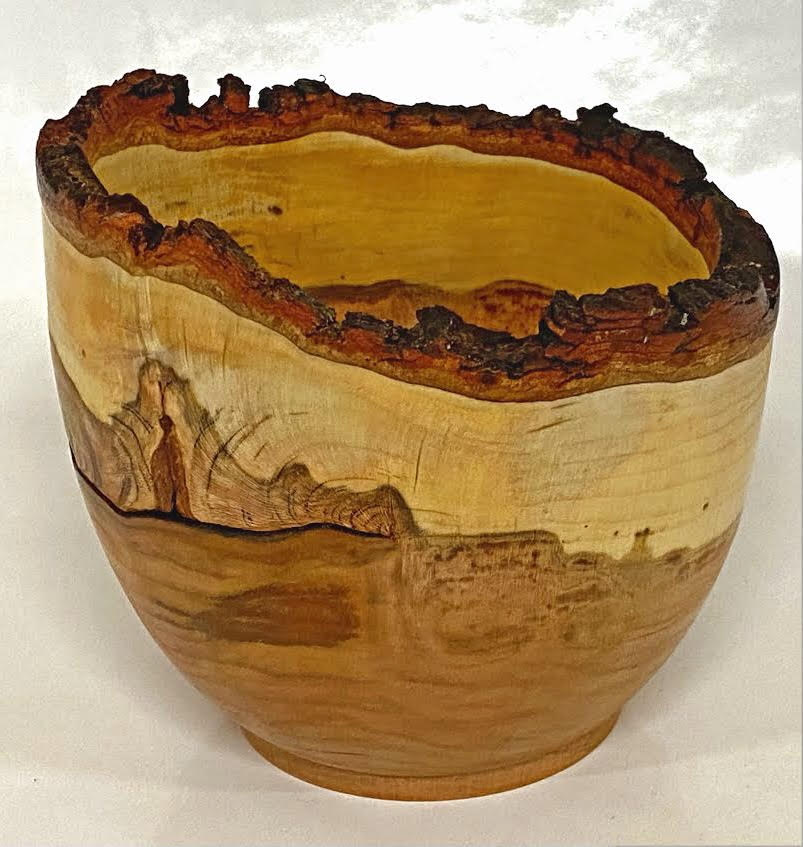
I knew enough about woodworking that I could draw parallels over into turning that I did not want a “cookie cutter” education system. I was ALL IN with ordering that lathe and receiving Jim’s generosity. I wanted to start my “trial and error” learning. So I started with the wood I had and the tools I had. The biggest deficit I had was I did not have a sharpening system. John Jordan recommended a particular one and the grits he used. While John is old school (sharpens freehand, without a jig), my tour of his shop, when ordering my Robust, revealed he has much more metalworking knowledge and experience than I have. I ordered the jig he suggested I avoid. While that sharpening system was more expensive than I hoped it would be, I have absolutely no regrets in purchasing it. My only regret was I didn’t order it when I ordered the lathe. My first bowl was dry, Bradford Pear. I turned it in an spindle orientation, so my end grain experience came turning the inside of that small bowl. I went through every tool I had and dulled every one! That experience taught me a lot about turning. Most of the lessons learned came months later as I learned techniques which could have helped me greatly.
I spent way more time sanding that bowl, than it should have taken me, also. But I was determined to produce a decent bowl out of that first attempt. Jim said, “This is better than some turners after a year of classes and turning!” My eye for quality was trained at the guitar factory. My wife hated shopping for wood furniture with me because my quality control expectations were way beyond our budget! But it serves me well when it comes to turning and not being satisfied too soon.
But my eye hand control needs several thousand hours of turning, yet. I still have to do more sanding because my touch is not up to par, yet. I am at the point where I need to destroy some plain pieces by practicing finishing cuts over and over until there is not enough left to be useful. Throw it away and do the same with a new chunk. Over and over. Over and over.
But the problem with doing that is I have created just enough demand for my work I don’t think I have time to do pure practice. People keep wanting to buy one of the pieces I have started experimenting in turning. Their requests keep my limited turning time tied up.
One of the educational turners I found was at TurnAWoodBowl.com. I watched all of his free videos early in my asynchronous learning (you can watch the next segment at your leisure, not when the teacher’s schedule allows). Kent gave a ton of good advice. Besides his videos, he has lots of good articles, suggestions and graphics which explain what he is writing about for visual learners. His graphics on cutting up a large log to remove the pith (the most unstable center region) and maximize the kinds of blanks you could possibly get (in an ideal world which doesn’t exist) are excellent! Glancing at his charts gives a beautiful road map to what to aim for, always adjusting for the different equipment he has compared to what you have. But that game plan to aim for has been so valuable for me.
Kent’s statements about his “love hate relationship with sanding” endeared me to him enough that I followed one of his links to Tried and True Original finish and bought a gallon (because it is so much cheaper that way). This became my “Go to Finish” and I still use it often, except…! Like I wrote earlier, there are many exceptions to lots of “rules” or recommendations.
There is a saying in woodturner’s groups which says, “Ask 10 turners a question, expect 11 different answers!” There is a slight exaggeration in this statement, but less than you might imagine.
Since there are two major orientation differences (parallel/spindle or perpendicular/bowl) thousands of species of wood (green to dry), hundreds of finishes, multiple glue, sanding and sharpening options, there are many preferences, and only a few absolute rules. But there are qualitative differences in the outcomes of some of those preferences. I prefer to take suggestions with a grain of salt. I highly prefer a recommendation which gives insights into why this advice is being recommended. I can learn from such recommendations, even if I choose to go at the problem differently AT THIS TIME! Later, I may experiment enough to decide that recommendation works better for me than what I was previously doing. But until I have that uninterrupted practice time for “trial and error” experience, please don’t attempt to push, cajole or try to shame me to do it your preferred way.
Turning is “spiritual” for me. Let me explain what I mean by that.

